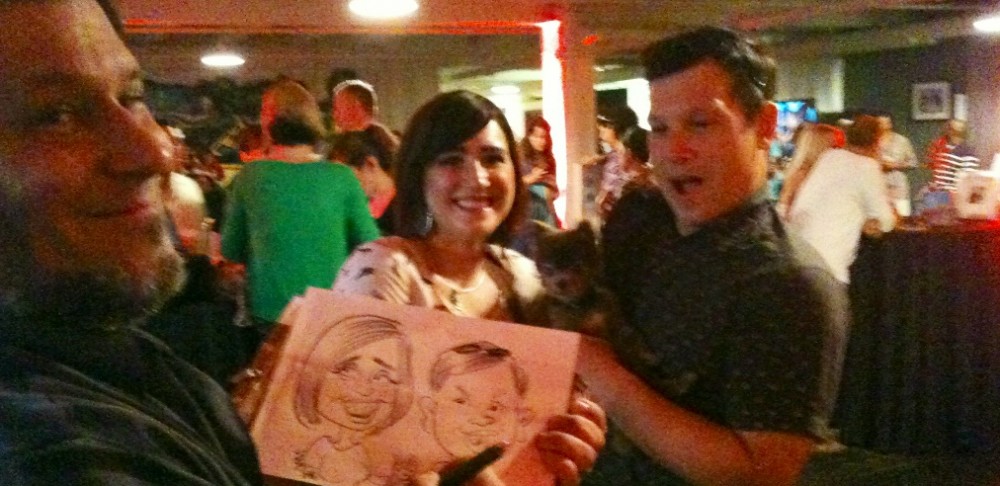
Observations of a young caricature artist…

When I was in grade school I was always drawing pictures of people, houses, pets, race cars, guns, motorcycles, vans, spaceships, dinosaurs, dragons, skulls, super heroes, ninjas,  etc… You name it! Nothing escaped my pencil. I used to carve things out of wood and build models out of paper. I had lots of ideas and inventions I was always drawing, building or writing about something. In class, I often got in trouble for drawing even though the teacher luckily encouraged me by telling me they liked it. It was something I loved to do and even better PEOPLE TOLD ME I WAS GOOD AT IT. In my opinion, people in general, teachers and parents specifically- seriously underestimate the power of positive reinforcement. (as well as the power of negative reinforcement…)

Early on they wanted to put me in LD classes because I had a hard time keeping still and paying attention in class. That lasted for about a week until my mother got wind of it. Luckily she asked them to put me in a regular classroom again. I suppose it was because I was disruptive somehow because of my attention disorder. They said I had a mild chemical imbalance. Knowing what I know now, I figure I could have maybe been slightly autistic or have had mild Asburgers too. I do not think this is uncommon at all. I think a lot of that went undiagnosed, especially back in the 70’s. It is difficult to say even now as it is still difficult to diagnose.

The reason I bring this up is because like many people with autism or asburgers, I was very interested in anomalies I would find in every day life and I saw relationships in things that other’s missed or were simply uninterested in. I was very observant, even as a kid, often to a fault. I wanted to see and touch things that I shouldn’t. My mom used to have to tell me to stop staring at people when I was very little and I often asked very personal questions that put people and my parents on the spot. I was unintentionally inclusive and socially awkward. I didn’t have many close friends growing up in the country in rural Ohio, but I wanted to socialize. It was hard because I grew up where I did and the things I noticed and asked about sometimes made people feel uncomfortable and as a consequence, I was sometimes treated differently or even cruelly. I was very competitive, was super strong and was interested in sports but knew nothing of the rules so I tended to avoid group games because I didn’t know how to play them and I would just seem clumsy, accidentally hurt someone or get in the way of the other kids.

Although squirmy and odd, I was a sweet kid who used to draw flowers and animals for my teachers, got decent grades and was a pretty good student for the most part- right up till the 4th grade. In 4th grade, my ADD or whatever made the teacher so uncomfortable that she put me in a corner and had a refrigerator box put around my desk so that I would not distract the rest of the class. She called it my office. This was a horrible thing to do to a child for many reasons, but at the time I didn’t think it was so bad sometimes. It gave me my own space to think and draw and get lost in my imagination. If I got bored in class I had the opportunity to look out the window or zone out on some project or another on my own and this kept me quiet and content for the most part for the rest of the school year. I had to see a school psychiatrist and I remember it being a very long, sad year for me. The box wasn’t helpful to me socially at all and I lost all interest in trying to be a good student.

I realize that (besides the “office”) most of this seems pretty common. It is. For me at the time it wasn’t of course. This was my perspective at the time. I thought I was different. People of influence encouraged my intellectual abilities, but I learned to keep those talents hidden as they were not helpful socially. This inclusiveness gave me the ability to see things objectively. I was an outsider, an observer. So I learned to enjoy playing quietly by myself and letting my imagination be my best friend, reading picture books to myself, learning about nature, observing and contemplating things in their natural state, noticing forms, textures, anatomy, positive and negative space, tangents, the color of lighting and the tones and shapes that shadows make at different times of the day, where they fall and how colors complimented one another. This further reinforced my relationship with my observational skills, imagination and creative abilities and has had an absolutely positive influence on the creative person I am today. These were the unintentional every day thoughts and influences on me as a young artist. …I think being hired to draw funny pictures of strangers at parties is about the most natural thing I could possibly do for a living!

Copyright Adam Pate, 2013

A Guy Walks Into A Bar, continued…

(LOCATION, LOCATION, LOCATION…

One of the most important considerations for most professional buskers is where they will perform their act. So much so that they will travel very far from their homes and families at certain times of the year to work a particular “Pitch” because of that location’s earning potential and popularity during a particular season, holiday or festival. A “Pitch” is the venue or place where the busker performs his talent in the appropriate area of a city.

Unfortunately, in some very popular pitch areas there are a limited number of suitable pitches available to multiple performers. (or one very good one that everybody wants to use) There are usually a few pitches in an area that are more popular because of size. A larger pitch allows the buskers to attract and accommodate a larger crowd and therefore the “hat” AKA the ‘take’, or amount of money that can be made per show, gets bigger.  Because the pitch is on public property, nobody can claim a right to it legally, so the performers must work it out among themselves so that the pitch may be rotated equally between performers, usually determined by seniority or on a first come first serve basis and in 20 minute increments with 10 minutes to collect tips and break down set up.

Please note: Although I have many friends who are performers, my personal experience with THIS type of busking is limited. That said, I think I know enough to communicate the gist of it. I am not as knowledgable about how the stage acts go because I am a roving performer and can perform all day- any place if I want to and do not need to attract a crowd to perform.

Different kinds of pitches suit different kinds of performances. This diversity allows for a friendlier and more successful busking scene overall and can allow certain performers to find a unique specialized pitch, that fits their specific needs with little or no competition (like myself doing caricatures). Having a variety of pitches attracts a variety of performers which makes the area that much more interesting to the people who visit busking friendly areas.

(Copyright, Adam Pate 2013)

SO A GUY WALKS INTO A BAR…

(Stop me if you’ve heard this one before…)

Chapter 1: An overview of “busking”.

Busking is a word that describes an entertainer, artist or musician of some kind performing for an individual or a crowd of random people, unbidden, in hopes of collecting tips, rewards or gratuities from the crowd based on the success of their performance. Larger tips are generally given according to popularity, skill level, comfort level and of course how good the performer is at collecting the tips.

People have been busking since Roman times. Recountours, Jongleurs, storytellers, bards, jesters, street artists, no matter what you want to call them, they’ve always been the counter-cultural stuntmen of society. Trying out unique tricks, artwork, music, stunts, poetry, dance, acrobatics, comedy, tragedy and everything in between (yes, even caricatures) for everybody from the unwashed masses to noblemen, politicians and clerics. Some of pop culture’s most famous performing icons started out busking: Simon and Garfunkel, Santana, Billy Joel, Bob Dylan, Jimmy Buffett, Louis Armstrong, Penn and Teller, Bob Hope, Cirque Du Soliel and The Blue Man Group, just to name a few…

As an entertainer, any time you can perform your particular brand of entertainment in public and get an immediate response it’s a great opportunity to learn, practice and get that much closer to becoming a master. If what you do has merit, you will do well. If the pay off is not to your liking you can try new things and discover what works best for you. Yes, that’s right- you can get paid to practice doing something fun! The money you make while busking is some of the hardest and most rewarding money you will ever make, because it is an immediate reward for your successful effort and the amount of the compensation for your effort is based directly on how worthy of reward random people have judged that effort to be. Busking can be a full time job, a useful skill, a way to meet girls, or just something fun to do with your friends in your spare time. In any case you will never go hungry once you’ve got the hang of it!

(Interesting note: It is widely regarded that a female will earn 3 ½ times more than a male doing the same exact performance.)

(An excerpt from the first chapter of “Successful Caricature Busking”, by Adam Pate, copyright, 2013)

Cedar Point. Sandusky, OH (1970’s)

When I was a kid we used to go to a place called Cedar Point, in Sandusky, OH once a summer or so. Usually it was on a field trip with the day care center I attended and we would have about $25 for the entire day. This was enough money for a few soft drinks, a few arcade games, some french fries or a hot dog and some small trinket to take home. Never did I have enough money to even think about getting a caricature from one of the many artists that would do them there. In fact I think I was afraid to even watch for too long for fear that I might have to pay to watch. It seemed to me that you should have to pay to watch anyways, it was pretty entertaining and it seemed like only paying customers were watching, mostly adults who looked like they could afford it, bored kids beside them. It was kinda expensive then just like it is now. I was too poor to get one, so were my parents and guardians who took me to the park so I never did get one. If I went with my parents I didn’t even get to watch unless I could sneak off.

Being a kid, everything seems pretty impressive if a grown up does it and you can’t figure out how they do it. I used to love to watch Bob Ross paint on PBS on Sunday afternoons. I learned a lot from that dude. There were other programs I’d watch about painting or drawing that added to my interest and skill level (I was always doodling, sketching something from life or trying to draw some idea from my imagination and put it on paper). I was a perfectionist. Always drawing lightly till I was happy with the shape of the line, sometimes drawing an entire drawing over again on another sheet of paper if it wasn’t just right, smudging tones with my finger or a tissue, erasing lines and drawing them again till I got it perfect. I couldn’t ever imagine drawing so confidently with a marker! It seemed pretty courageous to me to be doing that in front of a crowd one right after another like that- and making it look just like the person!  Not to mention the quality of the lines was so interesting and seemed completely effortless how they went from thin to thick then thin again in just the right way to create the illusion of depth (even though I didn’t understand what that was at such a young age). It was mesmerizing. One of my favorite things to watch was when I’d see an artist doing a close up video of their hand while drawing a comic book character or a cartoon on TV for a news program or a documentary. It amazed me how they would create one line out of the blank space on the paper, then the next, and the next, seemingly wholly disconnected and abstract, then somehow those lines suddenly became a recognizable subject and it seemed to come to life before my eyes. It was like magic! It was like that watching the caricature artist’s work at Cedar Point.

I completely understand why people are amazed at what I do for a living now and can’t blame them, even though it comes as second nature to me now. I totally am guilty of taking it for granted… I do like to make it a point to be entertaining and make sure people can see what I am doing close up. Especially kids! It’s very important to me because I know how wonderful it is to be inspired by it, even if it seems like something so simple to me now. I feel rewarded to be able to communicate visually to somebody something that they don’t understand but recognize about themselves instantly. I am happy to see the joy and interest on a child’s face as they watch me draw and answer their questions enthusiastically and encouragingly. I am sincerely humbled by it.

(Part 1. First chapter of my autobiography. Copyright: Adam Pate, 2013)